
Biologi
Miljö- och marinbiologi

Link to a web-camera viewing Solbergstrand´s outdoor mesocosms and the Oslofjord (position 59°36'56.45º N, 10º39'07.43º E):
Username: mfs Specialities / Areas of Interest Current position (1.10. 2007 – 30.9. 2012): Post doctoral scientist within the program ICZM (Integrated Coastal Zone Management) run by Åbo Akademi University and Sydväst Polytechnic in Ekenäs. 1.7. 2004 – 30.9. 2007: Post doctoral scientist at Environmental and Marine Biology, Åbo Akademi University, Åbo, and regular guest scientist during field work at Marine Research Station Solbergstrand, Norway, project: FAME (FActors Modifying Eutrophication responses in rocky shore communities) funded by The Academy of Finland (2004-2007), Ella och Georg Ehrnrooths Stiftelse (2004),Svenska Kulturfonden (2006-2007) and Societas pro Fauna et Flora Fennica (2004 and 2007). 1.4.-30.6. 2004: Post doctoral scientist at The Finnish Institute for Marine Research, project: ”BITIS” (Erkki Leppäkoski) under the research program BIREME (Academy of Finland 2003-2005). 21.5.2003-31.3.2004: Post doctoral scientist at Environmental and Marine Biology, Department of Biology, Åbo Akademi University and regular guest scientist during field work at Marine Research Station Solbergstrand, Norway, with funding from Svenska Kulturfonden, Ella och Georg Ehrnrooths Stiftelse, Svenska Litteratursällskapet i Finland and Societas Pro Fauna et Flora Fennica. 20.1-20.5.2003: Post doctoral scientist at Environmental and Marine Biology, Åbo Akademi University for Prof. Erik Bonsdorff within the project IMAGINE under the research program BIREME (Academy of Finland, 2003-06). 2001-2002: Post doctoral scientist at Environmental and Marine Biology, Department of Biology, Åbo Akademi University and regular guest scientist during field work at Marine Research Station Solbergstrand, Norway, with funding from Åbo Akademi University, Svenska Kulturfonden, Oskar Öflunds Stiftelse, Svenska Litteratursällskapet and Maj and Tor Nessling Foundation. 1998-2001: Full time partner (leading scientist from Åbo Akademi University) in the international EU-project EULIT (Effects of Eutrophicated Seawater on Rocky Shore Ecosystems Studied in Large Littoral Mesocosms) carried out at Marine Research Station Solbergstrand in Norway. 1995-1998: PhD-student in the graduate school "Integrated Aquatic Hazard Assessment" by the Finnish Ministry of Education. 1994: Scientist at Åbo Akademi University. 1993-1994: Visiting scientist at the Marine Research Station Solbergstrand of the Norwegian Institute for Water Research (NIVA) by the Oslofjord, Norway, during 4 months. 1989-1993: Scientist at the Baltic Sea Laboratory of the Finnish Environmental Research Group in Nagu/Nauvo Finland. Specialities / Areas of interest
CONTEXT 2008-2010 – COmmunity impacts of Nutrient enrichment, raised seawater Temperatures and increased EXTernal predation: CONTrolled EXperimenTs on rocky shores.
CONTEXT – project description Human-induced pressures such as excessive nutrient input, climatic changes and over fishing are currently at an ever-increasing rate threatening temperate sea areas and large ecosystem changes can already be observed. Such changes may occur when a tipping point is reached or exceeded and one community structure shifts towards another, the new system often having different functions and ecosystem processes than the previous one. One example is the regime shift along the south Norwegian and Baltic Sea coasts, where filamentous ephemeral algae largely have replaced kelp and seaweed. Surprisingly little is known, however, about how marine ecosystems respond to, and evolve with, a changing environment. The absence of data and relevant models make tipping points difficult to predict, and they often go unrecognised until the ecosystem change has already taken place (e.g. the perennial-ephemeral algae transition). Predicting the nature, scope and likely timing of tipping points requires extensive knowledge of the ecological responses involved and the tolerance thresholds of the species at different life-stages. Making accurate predictions is especially challenging when combined effects of different natural and anthropogenic factors are involved. Without an experimentally based understanding of the causes and consequences of ecosystem tipping, however, it is impossible to develop indicators of the stability of our marine ecosystems. CONTEXT builds partly on a previous long-term project, FAME 2004-2007 (FActors Modifying Eutrophication responses in rocky shore communities), and shares the common intention of clarifying eutrophication mechanisms (possible buffering/modifying physical and biological factors) and elucidating long-term responses to human pressure within temperate hard bottom (littoral rocky shore) plant and animal communities. As its preceding project, CONTEXT will utilise experimental ecosystems (mesocosms) at Marine Research Station Solbergstrand by the Oslofjord, Norway, but also field and aquarium experiments in Finland and in Norway. While FAME concentrated on the possible buffering of eutrophication responses by physical and biological processes such as wave action, canopy disturbance and grazing, the overall objective of CONTEXT is to test and quantify rocky shore community responses to three human-induced pressures: 1) nutrient enrichment, 2) increased sea water temperature (as a simulation of global warming / climate change) and 3) presence/absence of intermediate predators (increased numbers of small-sized predators due to over fishing, predators which may e.g. reduce grazing pressure on short-lived algae and accentuate the eutrophication process). The main hypothesis is that all involved factors over a longer time period will have significant effects on the structure and function of littoral ecosystems, but that the final result, i.e. occurrence of community change or tipping, largely will depend on interactions among the studied factors. The idea is to use mesocosms to exert experimental control over nutrient enrichment levels, seawater temperatures and pressure from intermediate predators and to use factorial analysis of variance and split-plot ANOVA to test the factors one by one and in various combinations (interactions). CONTEXT will share the use of the Solbergstrand mesocosms with the Norwegian project SACCHARINA (Norwegian Science Foundation 2007-2010), a project which in parallel will investigate responses in sugar kelp, Saccharina latissima, to the very same human-induced pressures. While doing all these measurements, reliable new quantitative information about the responses to human impact in rocky shore communities can be obtained, which may serve as a decision support for the monitoring and management of our marine resources. This is especially important in connection with risk assessment of marine nutrient outfalls, global warming and cascading effects connected to over fishing of top predators, but also for making scientifically sound decisions about possible remedial actions. Information about changes in species composition in rocky littoral ecosystems will in addition be of great relevance for issues of marine biodiversity as well as for the sustainable use of coastal ecosystems within fishery and aquaculture and for recreation purposes. As human stress on ecosystems seldom is operating as a single pressure, a combined investigation of several stressors at once adds extra strength into the CONTEXT initiative. CONTEXT will be testing the following hypotheses: 1. Increased nutrient loading (factor 1) will stimulate colonisation, growth and accumulation of opportunistic algae at the cost of climax canopy species and cause increased export of organic matter and possibly decreased community diversity, 2. Increased seawater temperatures (factor 2) will stimulate nutrient uptake rates and growth of ephemeral algae and may therefore accentuate the impact of nutrient enrichment on perennial algae through increased competition for nutrients, space and light, However, increased temperatures may also stimulate the abundance and metabolic activity of grazers, which in turn may serve to counteract the increase in ephemeral algae. 3. Increased intermediate predation (factor 3) will decrease the community structuring effects imposed by herbivores/ grazers and may therefore also accentuate the impact of nutrient enrichment on the macroalgal communities, 4. The combined effects of high nutrient levels, high seawater temperatures and presence of intermediate predators will most probably affect the rocky shore communities negatively, i.e. may induce ecosystem tipping, whereas the absence of one or two of these pressures/factors may affect such communities less severely. CONTEXT is a long-term project, which will start in spring 2008 by an even out of the mesocosm macroalgal and macrofaunal communities (to cover up from previous experimentation) and a manipulation of the study factors. The alteration of nutrient inputs (factor 1, addition of +32 mM nitrate and 2 mM phosphate above background levels) and seawater temperatures (factor 2, raised sea water temperatures by 2-3 °C) will be applied factorially to the mesocosms (two levels, high and low, of each factor, replicated two-way factorial design), whereas the impact of intermediate predation (factor 3) will be tested within mesocosms using closed and open cages and a split-plot experimental approach at the analysis. The study variables are mainly at the population and community level, like abundance and biomass of dominating animals, degree of cover and biomass of plants and biodiversity, but measurements at the individual and ecosystem levels (production estimates) will also be included. Most monitoring of the mesocosm systems will be done three times annually. Both univariate and multivariate techniques will be applied in the statistical data analysis. Field and aquarium experiments (in Finland and Norway) will be used to study specific research questions. In addition to the experimental work, it will be attempted to use existing data and correlate previous community responses to nutrients (e.g. increase in green algae) to corresponding weather conditions (e.g. sea water temperature, light) for each specific former experimental year 1998-2007. With regard to expected results and their applicability, CONTEXT is a problem-oriented (applied) initiative that step-wise examines cause-effect relationships at the population level and trough interactions at the community and ecosystem level directly produces quantitative data about human pressure and impact on rocky shore communities. CONTEXT is the first study ever to evaluate the combined effects of nutrient availability, raised seawater temperatures and increased intermediate predation on rocky littoral algal and macrofaunal assemblages. The project improves the present “state of the art” considerably by increasing the conceptual basis needed to provide a more diverse understanding of how chemical, physical and biological factors may interact to structure shore communities. The overall intention is to produce strictly controlled quantitative data, which may further be used for extrapolation to the field and for modelling different future scenarios. A successful accomplishment of CONTEXT will be of great aid in putting the impact on rocky shores of the abovementioned human pressures into a bigger context.
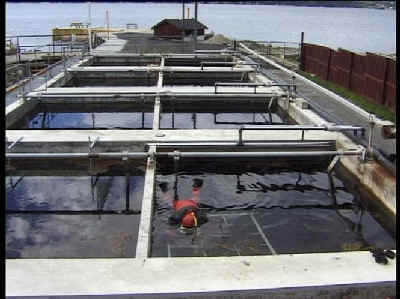
Picture of the rocky littoral mesocosms at Solbergstrand
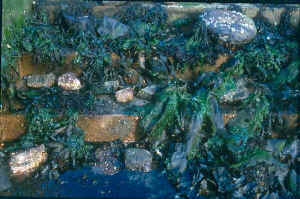
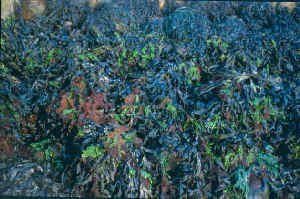
Picture of mesocosm treated with nutrients (left) and control mesocosm (right) CONTEXT - Sammanfattning på svenskaProjektet CONTEXT avser testa hur fysiska och biologiska processer kan påverka responser till näringsämnen på hårdbottenstränder och hur klippstrandssamhällen genom export kan bidra med ökad organisk belastning till omgivande ekosystem. CONTEXT använder Solbergstrands åtta littorala utomhusmesokosmer, och projektet har huvudsakligen designats för statistisk data-analys med tvåvägs faktoriell ANOVA, fast även split-plot tekniker kommer att tillämpas. Dessa analyser strävar efter att etablera sanna orsak-verkan samband för näringstillsats (Faktor 1: N och P dosering, resultat av eutrofiering) och temperaturökning (Faktor 2: ökad havsvattentemperatur, resultat av global uppvärmning) och att få information om deras separata eller kombinerade roll för upprätthållande av oförstörda opåverkade hårdbottensamhällen eller uppkomst och påskyndande av eutrofieringseffekter (inkluderat de involverade tidsskalorna). En biologisk process kommer därtill att undersökas som underfaktor, d.v.s. ökad förekomst av intermediära predatorer som kan minska den naturliga betningen (med hjälp av burar kommer vissa bassängområden att vara utsatta för större mängd intermediär predation från småfisk och tångräkor, simulerande en möjlig följd av överfiske av toppredatorer). Som responsvariabler registreras: täckningsgrader och biomassa av alger, abundans av djur och biodiversitet, exportrater av alger och djur, ackumulering av alger samt hela hårdbottensamhällenas produktion (g kol per ytenhet och tid, från regelbundna momentana produktionsmätningar genom användning av pH-förändringar under dag/natt samt genom estimering av mängden producerad algbiomassa över längre tid). Experimenten i modellekosystem kommer att kompletteras med akvarie- och fältundersökningar i Finland och i Norge och avsikten är också att producera strikt kontrollerat kvantitativt data, som kan användas vidare för extrapolering till fältförhållanden och för modellering av olika framtida scenarion. Ett framgångsrikt genomförande av CONTEXT kommer förhoppningsvis att kunna sätta inverkan av dessa ovannämnda mänskliga aktiviteter på hårdbottenstränder in i en större kontext. Co-operation (CONTEXT and other projects)
Karlsson, P. & J. Granlund, 1991. Naturinventering i Nykarleby. 303 pp. (In Swedish) Lehtinen, K-J., J. Tana, P. Karlsson, C. Engström, K. Mattsson, S. Hemming, J. Hemming & A-L. Fugelberg, 1992. Chemical characterizationand effects in mesocosms of effluents from bleached hardwood kraft pulp production. - Publ. Fin. Nat. Board Wat. Env. Adm. - series A 105: 57-107. Lehtinen, K-J., J. Tana, P. Karlsson, C. Grotell, K. Mattsson, S. Hemming, C. Engström & J. Hemming, 1993. Effects in Baltic Sea littoral mesocosms of externally treated effluents from production of chemical and thermomechanical pulp and pure phytosterols. - Publ. Fin. Nat. Board Wat. Env. Adm. - series A 133: 67-139. Kraufvelin, P., 1998. Model ecosystem replicability challenged by the "soft" reality of a hard bottom mesocosm. J. Exp. Mar. Biol. 222 (1-2): 247-267. (Click for pdf, pdf1). Bokn, T.L., H. Christie, C.M. Duarte, O. Geertz-Hansen, E.E. Hoell, K. Kersting, P. Kraufvelin, C. Lindblad., M.F. Pedersen, U. Sommer & F. Moy, 1998. Effects of eutrophicated seawater on rocky shore ecosystems studied in large littoral mesocosms - EULIT. In: Barthel, K.-G., H. Barth, M. Bohle-Carbonell, C. Fragakis, E. Lipiatou, P. Martin, G. Ollier & M. Weydert (eds), Project Synopses from Third European Marine Science and Technology Conference, Lisbon 23-27 May 1998, Volume II, Strategic Marine Research, pp. 871-876. Kraufvelin, P., 1999. Baltic hard bottom mesocosms unplugged: Replicability, repeatability and ecological realism examined by non-parametric multivariate techniques. J. Exp. Mar. Biol. Ecol. 240 (2): 229-258. (Click for pdf, pdf2). Kraufvelin, P., 2000. Detecting change in marine zoobenthic communities by large-scale and long-term mesocosm experiments and field studies. Ph.D.-thesis. Åbo Akademi University. 58 pp. Kraufvelin, P., B. Sinisalo, E. Leppäkoski, J. Mattila & E. Bonsdorff, 2001. Changes in zoobenthic community structure after pollution abatement from fish farms in the Archipelago Sea (N Baltic Sea). Mar. Environ. Res. 51 (3): 229-245. (Click for pdf, pdf3). Kraufvelin, P., H. Christie & M. Olsen, 2002. Littoral macrofauna (secondary) responses to experimental nutrient addition to rocky shore mesocosms and a coastal lagoon. Hydrobiologia 484: 149-166. (Click for pdf, pdf4). Bokn, T.L., B. Bjerkeng, H. Christie, C. Duarte, E. Hoell, R. Karez, K. Kersting, P. Kraufvelin, C. Lindblad, N. Marba, F. Moy, M. Olsen, M.F. Pedersen, U. Sommer, 2002. Are rocky shore ecosystems affected by nutrient enriched seawater? Some preliminary results from a mesocosm experiment. Hydrobiologia 484: 167-175. (Click for pdf, pdf5). Bokn, T.L., C.M. Duarte, M.F. Pedersen, N. Marbá, F.E. Moy, C. Barrón, B. Bjerkeng, J. Borum, H. Christie, S. Engelbert, F.L. Fotel, E.E. Hoell, R. Karez, K. Kersting, P. Kraufvelin, C. Lindblad, M. Olsen, K.A. Sanderud, U. Sommer & K. Sørensen, 2003. The response of experimental rocky shore communities to nutrient additions. Ecosystems 6 (6): 577-594. (Click for pdf, pdf6). Christie, H. & P. Kraufvelin, 2004. Mechanisms regulating amphipod population density within macroalgal communities with restricted predator impact. Sci. Mar. 68 (Suppl. 1): 189-198. (Click for pdf, pdf 7). Karez, R., S. Engelbert, P. Kraufvelin, M.F. Pedersen & U. Sommer, 2004. Biomass response and changes in composition of ephemeral macroalgal assemblages along an experimental gradient of nutrient enrichment. Aquat. Bot. 78: 103-117. (Click for pdf, pdf 8). Salovius, S. & P. Kraufvelin, 2004. Filamentous green alga Cladophora glomerata as a habitat for littoral macrofauna in the Northern Baltic Sea. Ophelia 58 (2): 65-78.(Click for pdf, pdf 9). Kraufvelin, P. & S. Salovius, 2004. Animal diversity in Baltic rocky shore macroalgae: Can Cladophora glomerata compensate for lost Fucus vesiculosus? Estuar. Coast. Shelf Sci. 61 (2): 369-378. (Click for pdf, pdf 10). Kraufvelin, P., S. Salovius, H. Christie, F.E. Moy, R. Karez & M.F. Pedersen, 2006a. Eutrophication-induced changes in benthic algae affect the behaviour and fitness of the marine amphipod Gammarus locusta. Aquat. Bot. 84: 199-209. (Click for pdf, pdf 11). Kraufvelin P., F.E. Moy, H. Christie & T.L. Bokn, 2006b. Nutrient addition to experimental rocky shore communities revisited: delayed responses, rapid recovery. Ecosystems 9: 1076-1093 (Click for pdf, pdf 12). Kraufvelin, P., A.T. Ruuskanen, N. Nappu & M. Kiirikki, 2007. Winter colonisation and succession of filamentous algae and possible relationships to Fucus vesiculosus settlement in early summer. Estuar. Coast. Shelf Sci. 72: 665-674. (Click for pdf, pdf 13). Kraufvelin, P., 2007. Responses to nutrient enrichment, wave action and disturbance in rocky shore communities. Aquat. Bot. doi:10.1016/j.aquabot.2007.06.011 (In press). (Click for pdf, pdf 14) Paavola, M., A.O. Laine, M. Helavuori & P. Kraufvelin, 2007. Profiling four brackish water harbours: zoobenthic composition and invasion status. Bor. Environ. Res. (In press). (Click for pdf, pdf 15)
Submitted or in preparation Carlsson, R., C.-A. Häggström & P. Kraufvelin, 2007. The vascular plant flora of shell gravel deposits on the Åland Islands, SW Finland – community structure in relation to calcium. Bor. Environ. Res. (Submitted). Kraufvelin, P., J. Perus & E. Bonsdorff. Scale-dependent distribution of soft-bottom infauna in the species-poor northern Baltic Sea. Mar. Ecol. Prog. Ser.(In preparation). Kraufvelin, P., A. Lindholm, M.F. Pedersen & E. Bonsdorff. Productivity in relation to macroalgal community structure on temperate rocky shores – experimental investigation of functional aspects of biodiversity. J. Exp. Mar. Biol. Ecol. (In preparation). Kraufvelin, P., A.T. Ruuskanen, S. Korpinen & P. Kangas. Long-term changes in macrofaunal communities associated to Fucus vesiculosus and filamentous algae at the Finnish south coast. Ann. Zool. Fenn.(In preparation). Kraufvelin, P. Long-term impacts of nutrient enrichment and reduced wave action on the biomass of rocky littoral macroalgae. Ecosystems (In preparation). Laine, A.O. & P. Kraufvelin. Has the alien polychaete Marenzelleria viridis altered native sediment macrofauna communities along the Finnish coast? J. Sea Res. (In preparation). Ruuskanen, A.T., S. Bäck, P. Kraufvelin & G. Russell. Effects of increased spring sea temperatures on the reproductive phenology of Baltic Fucus vesiculosus (L.). Bor. Environ. Res.(In preparation).
|
Uppdaterad 4.10.2007